
Ask most families a simple question: how many times has each college seen your athlete play?
Most can’t answer. Every sighting feels the same, whether a coach drifted by for ten minutes or came back for a second game. But the count is the signal, and the third look from a college coach is the one worth planning around.
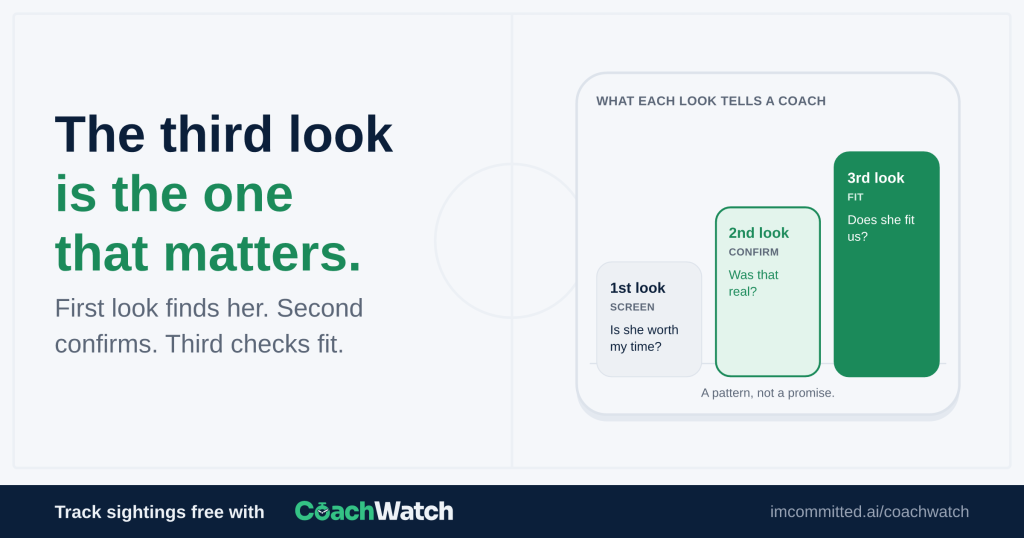
What each look tells a coach
- First look: “Is she worth my time?” Often a coach is working down a long list, or there for someone else.
- Second look: “Was that real?” Coming back to the same showcase, twice in a weekend, is a good sign. The coach is checking that the first impression wasn’t a lucky game.
- Third look: “Does she fit us?” By now the coach knows she can play. This look is about fit: a different opponent, a hard half, how she treats her teammates. It is also when a coach is more likely to bring someone else for a second opinion.
In our experience, the third look is where a coach stops screening and starts deciding. My daughter had multiple coaches tell her on the phone that they wanted to see her “again” or a “third” time before offering a visit. Because I had the data I knew who had seen her and how many times… it was almost always a third time or a third coach.
Why the third look matters for your family
A third look is a cue that a coach is interested. Once she is past the date when coaches can talk to her (June 15 after sophomore year for D1 and D2 women’s soccer), it may be the right moment for a personal email from your athlete, asking for a visit or to learn more about the school and program. It’s also the point where silence stops being neutral. If a coach has seen her three times and you’ve heard nothing, that’s worth noticing (see the five recruiting signals worth tracking).
Write the email the way she would say it: where you saw the coach, one moment from the game, and one clear next step.
How to earn repeat looks
- Invite them to showcases and tournaments, where several coaches see several games in one weekend.
- Show real interest in the program, and show how she solves a problem for them: speed, goals, a back line that doesn’t concede.
- Choose ID camps carefully, because a camp is only worth it if the coaches there matter to your list (which showcases are worth the money uses the same math)
- Send the updates in between: a new schedule, a big win, semester grades (the showcase schedule email)
Three cautions before you count
- Check who the coach came to see. A coach at three games may be there for a teammate or the other team’s player. A count only matters if it’s about your athlete.
- Check which coach. An assistant visiting three times is different from a head coach visiting once.
- Three is a pattern, not a promise. A look is a signal, not an offer. Nobody can promise an offer or a scholarship, and we don’t.
Counting takes a record
A school name in a group text can’t be counted. A list kept across games can. CoachWatch builds that list for free, one game at a time: a parent taps the coach as they arrive, then sends one list, and every family on the team gets the same one. Start with why “Miami was here” isn’t a coach list, then set up a rotation with four parents, two per half, one list.
Once you have the list, the first 48 hours after a showcase shows how to sort it, and what it means when a coach watches keeps a single sighting in perspective.
Where the rules fit in
What a coach can say to a family, and when, depends on the level and the date, so a coach who stays quiet may simply be following the rules. Check the NCAA’s official recruiting page and the governing body for your athlete’s level rather than relying on a group chat.
Start counting. Get the free CoachWatch Android beta.
I’mCommitted.ai, the recruiting app we’re building, is designed to keep those looks together across a whole season, so you can see which coaches are moving from Get Noticed toward Build Relationships.
Related reading: how coaches scout at showcases, talking to a coach at the game, showcase weekend etiquette.