
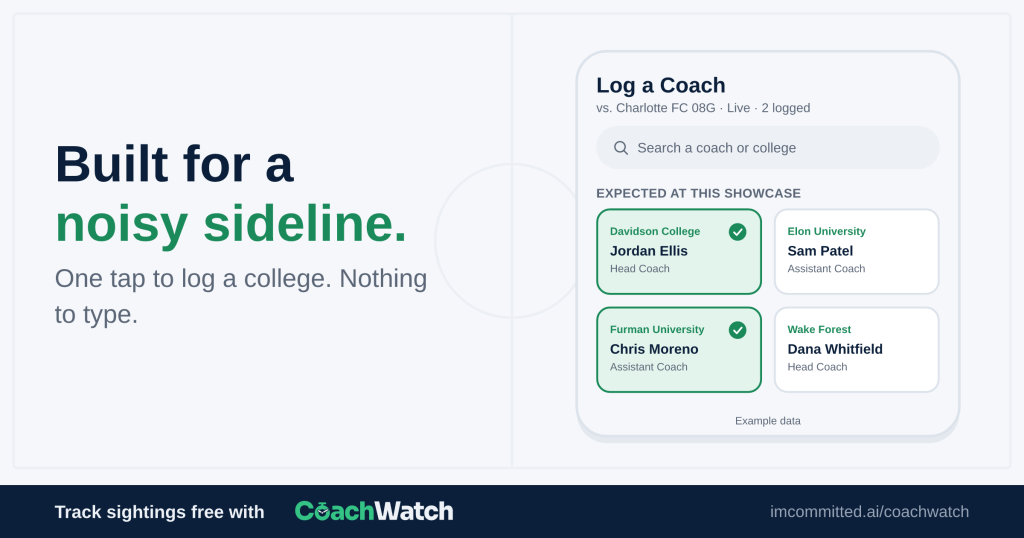
Here’s the real sideline at a showcase.
Twenty-plus fields going at once. A parent holding a coffee, a folding chair and a phone. A whistle every thirty seconds. Somebody’s grandmother shouting. And maybe thirty seconds of attention to spare when a coach walks up.
That’s the design brief for a soccer sideline app. We didn’t build CoachWatch for a quiet desk. We built it for a cold, noisy sideline, where the parent holding the phone is also trying to watch their own kid play.
What we believe a soccer sideline app has to do
- One or two taps. You tap the coach’s card and you’re done. Anything that takes more than a few seconds loses.
- A big button. Fat fingers, gloves, bright sun.
- Almost nothing to type. The coaches expected at the showcase are already on cards. Typing on a sideline never works.
- Shared. Everyone on the game code works from the same list, and a coach tapped twice is logged once.
- No pressure. You can add details later or not at all.
Why we split the job between parents
Nobody wants to spend the whole match watching the sideline for coaches, and one person can’t cover all four sides anyway. Split the job and you have two lists to combine. CoachWatch was built so that split is fast, easy and accurate.
What we wanted parents to end up with
A group chat that says “Miami was here” is a kind thing for a parent to send, but it isn’t a list (why “Miami was here” isn’t a coach list). We wanted every family on the team to end up with the same record: the school, the coach and how to reach them, in one file, right after the game.
Why we built CoachWatch
Our founder’s daughter plays D1 soccer at her first-choice school. He helped market her team, ran its Instagram account, and spent countless hours taking photos on the touchline and watching games from a distance. He also traveled as a consultant and used the time to research college recruiting, which is where he learned how much being seen by college coaches matters.
On showcase weekends he spent hours editing photos, typing up the schools and coaches who attended, and looking up coaches’ email addresses so his daughter could follow up. It took hours each trip and caused more stress than it needed to for both of them. CoachWatch is the fix for the list, and the list is a key input for I’mCommitted.ai.
What we’re still learning
A sideline is different at every field. Some have a gate everyone walks through, and some have a parking lot and a hill. Some teams have enough volunteers for a full rotation, and some have two tired parents. We’re building for all of them, and the beta is how we find the cases we missed.
If you’ve tracked coaches at a showcase before, tell us what you wish you’d had. If you haven’t, try it at your next game and tell us where it got in the way. Either note helps.
What happens after the game
Once the final whistle blows, you send the link to the rest of the team and everyone gets the list. From there it’s about what you do with it: the first 48 hours after a showcase shows how to sort it, and what it means when a coach watches keeps a sighting in perspective.
Rules about what coaches can say to families differ by level and date. For those, check the NCAA’s official recruiting page.
Try the free beta and tell us what we missed.
CoachWatch tells you who showed up. I’mCommitted.ai, the recruiting app we’re building, helps your athlete do something about it.